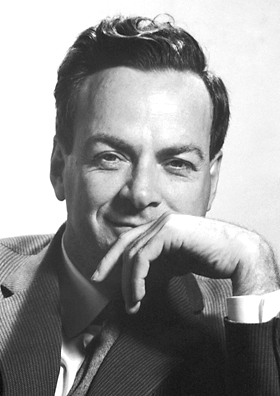
The first principle is that you must not fool yourself
Aphorism
I do theoretical physics research: I built a working quantum electrodynamics, invented the diagrams physicists now use to calculate with it, and shared the 1965 Nobel Prize in Physics for that science.
Explained Challenger O-ring failure on live TV
4 milestones
As part of the Rogers Commission, demonstrated how Shuttle O-rings failed, exposing design and management flaws.
Introduced partons to explain deep inelastic scattering, clarifying the relationship to quarks.
Foresaw the potential of atomic-scale engineering and miniaturization in a 1959 Caltech talk.
At Los Alamos during the Manhattan Project, developed quantitative yield estimates with colleagues.
Teaching in Brazil, reviewing California textbooks in 1964 and addressing science teachers in 1966, I argued that education built on rote memorisation does not produce learning; science teaching must train doubt.
Burned out after the war, I started solving physics problems for my own satisfaction — like a wobbling plate tossed in the Cornell cafeteria. That play with rotation equations proved important to my Nobel-winning science.