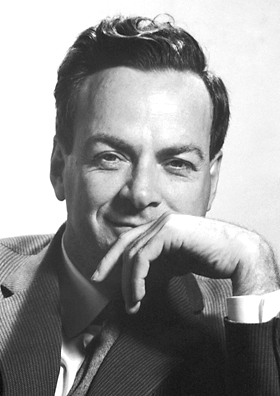
Physics for fun brought me back to real research
Burned out after the war, I started solving physics problems for my own satisfaction — like a wobbling plate tossed in the Cornell cafeteria. That play with rotation equations proved important to my Nobel-winning science.
curiositylearningtheoretical physics+1 more
My thesis work laid the path integral groundwork
My undergraduate thesis gave the Hellmann–Feynman theorem, and my 1942 Princeton doctorate applied the principle of stationary action to quantum mechanics — the research basis for path integrals and my diagrams.
quantum mechanicspath integralstheoretical physics+1 more
I worked on all four fundamental forces of nature
My Caltech research spanned electromagnetism, the weak force, the strong force and gravity: superfluid helium, the V–A theory of weak decay with Gell-Mann, partons, gravity ghosts and early quantum computing.
theoretical physicsparticle physicsquantum computing+1 more
In 1959 I proposed machines that arrange atoms at will
In my 1959 Caltech lecture I described machines built at atomic scale, chemical synthesis by mechanical manipulation, and a swallowable surgical robot — a talk now frequently cited in nanotechnology and microtechnology research.
nanotechnologyengineeringminiaturization+1 more
My Caltech lectures became The Feynman Lectures on Physics
Asked in the early 1960s to "spruce up" Caltech's undergraduate teaching, I spent three years building an introductory physics course that became The Feynman Lectures on Physics, still selling for its deep understanding of the science.
educationteachingphysics+1 more
Students who memorise without context learn no physics
Teaching in Brazil, reviewing California textbooks in 1964 and addressing science teachers in 1966, I argued that education built on rote memorisation does not produce learning; science teaching must train doubt.
educationteachingscience education+1 more
What I cannot create I do not understand
I chalked this line on my blackboard at Caltech. It sums up how I do physics: I understand a result only when I can rebuild it myself.
understandingphilosophy of scienceteaching
The first principle is that you must not fool yourself
In my 1974 Caltech commencement address on cargo cult science I told graduates that scientific research rests on a kind of utter honesty, and that it starts with not fooling yourself.
scientific integrityphilosophy of scienceresearch
I explained the SLAC scattering data with partons
When SLAC's late-1960s deep inelastic scattering experiments showed point-like particles inside protons and neutrons, my parton model read the research data without extra hypotheses — including the 45% of momentum carried by neutral particles.
particle physicsparton modeltheoretical physics+1 more
How I made enriched uranium storage criticality-safe
At the Oak Ridge enrichment plant I helped engineers devise storage procedures so enriched uranium could not reach criticality, and I insisted on teaching the workers the nuclear physics behind the rules.
nuclear physicscriticality safetyengineering+1 more